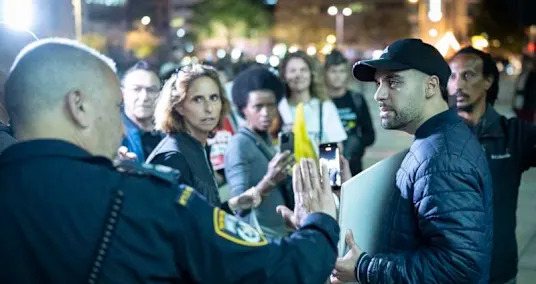
Protests took place in Tel Aviv, Jerusalem, Haifa, and Beersheba, as a survey found broad but uneven support among Jewish Israelis for Operation Roaring Lion.
Israel Police arrested 21 anti-war protesters Saturday night as demonstrations against the conflict with Iran expanded in multiple cities despite restrictions on public gatherings.
Protests took place in Tel Aviv, Jerusalem, Haifa, and Beersheba, with hundreds of participants reported in Tel Aviv and Jerusalem and about 100 in Haifa, marking the largest turnout since weekly demonstrations began. Authorities said 13 people were arrested in Tel Aviv and eight in Haifa.
Police said the gatherings were not approved under Home Front Command regulations that ban events with more than 50 people. Officials said the increase in turnout followed calls by groups opposing the government to protest despite the restrictions.
“During a situation assessment that took place at the scene with a Home Front Command representative… it was clarified that there was a real risk to human life and accordingly, Yarkon [precinct] police commander Tzachi Sharabi ordered the gathering to be dispersed,” police said.
Hadash-Ta’al chairman Ayman Odeh, an Arab lawmaker involved in the protests, criticized the police response, calling officers fascists “in the service of the government” and saying they were afraid of “the heroic citizens who went out, despite everything, to make their voice heard.”

Survey shows broad, uneven support for war
The demonstrations come as a March 2026 survey by the Israel Democracy Institute found broad but uneven support among Jewish Israelis for Operation Roaring Lion. Support was strongest on the Right at 87% and about half on the Left.
The survey also found that Jewish and Arab respondents largely agreed that Iran’s resilience has been stronger than expected. Most Jewish respondents said Israeli society could sustain the campaign for up to one month, while 28% said as long as needed. Arab respondents were less optimistic about how long the public could endure the conflict.
A majority of Jewish respondents said Prime Minister Benjamin Netanyahu’s decision was driven by security considerations, while most Arab respondents viewed it as political.
LATEST POSTS
- 1
 One third of Spanish pork export certificates blocked since swine fever outbreak, minister says
 - 26 Eyewear Brands Worth Purchasing
- 3What happened in 'Wicked' part 1 and will there be a 3rd movie? Recap and what Ariana Grande, Jon M. Chu have said about a sequel.
- 4Two IDF officers, civilian face indictment in alleged Gaza aid-truck smuggling scheme
- 5Rebecca Gayheart on her 'very complicated' relationship with Eric Dane: 'I am always going to want the best for him'




- How Mars 'punches above its weight' to influence Earth's climate
- NASA Artemis II tracker: Crew less than 60,000 miles from moon ahead of Monday flyby
- This Underrated Italian City Boasts Indulgent Food & Captivating Views For A Romantic Escape
- Timex Gives Its Classic Affordable Field Watch a Tactical, Milspec Makeover
- Interstellar comet 3I/ATLAS reveals weird wobbling jets in rare sun-facing tail
- Change Your Home into an Exercise center with These Famous Wellness Gadgets
- Iran War Derails The Automotive Industry
- Surprising links between autism, Alzheimer’s could change how we treat both
- 'Euphoria' releases Season 3 photos with Zendaya, Sydney Sweeney, Jacob Elordi and others: See them