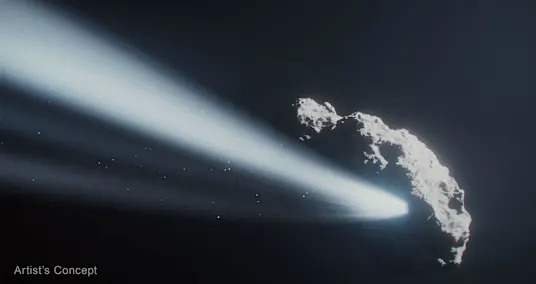
Astronomers have found archival data showing a one-of-a-kind event where a spinning comet appeared to reverse the direction of its rotation, NASA said in a news release.
The comet, named 41P/Tuttle-Giacobini-Kresák, originated in the outer solar system and visits the inner solar system every 5.4 years, NASA said. During a pass around the sun in 2017, its rotation dramatically slowed. A data comparison of its movements showed that in May 2017, it rotated three times more slowly than in March of that year.
Recently, NASA scientists conducted a new analysis of those observations and saw that the comet had made even more surprising moves. Images from December 2017 showed the comet spinning faster than in May.
Researchers determined that the comet likely continued slowing until it nearly stopped. Then, as it approached the sun, heat melted frozen ice on the comet's surface, creating "jets of gas" that "can act like small thrusters," said David Jewitt, an astronomer at the University of California at Los Angeles who published a paper about the comet's movements. The comet also had a small nucleus, making it easy for it to rotate.
Eventually, the jets' push against the original motion slowed it down until they eventually forced the comet to spin the other way. An animated video by NASA shows an artist's rendering of the process.

"It's like pushing a merry-go-round," Jewitt said in NASA's news release. "If it's turning in one direction, and then you push against that, you can slow it and reverse it."
Jewitt said he expects the nucleus will "very quickly self-destruct." Archival data from its 2001 passage shows the comet was very active at the time, and scientists were able to determine that activity had decreased significantly by 2017. The comet's surface may be evolving quickly, NASA said. Typically, comets evolve over centuries, but because of the comet's rotational shifts, the changes are happening faster.
Continued rotational changes might mean the comet eventually becomes unstable, potentially leading to its fragmentation or disintegration, NASA said.
NASA said the discovery shows the importance of the space agency's publicly accessible data.
"Observations made years, or even decades ago, can be revisited to answer new scientific questions," the agency said. "In many cases, scientists continue to make discoveries not just with new observations, but by mining the archive built over decades of space exploration."
Latest on jury deliberations in California social media addiction case
Trump reveals Iran apparently gifted the U.S. boats of oil that moved through Strait of Hormuz
Congress prepares to vote on DHS funding that could end TSA chaos
LATEST POSTS
- 1
 Eleven arrested over mass shooting in South Africa tavern
 - 2France's Senate backs ban on social media platforms for under-15s
- 3Book excerpt: "Eat Your Ice Cream" by Ezekiel J. Emanuel, M.D.
- 4Vaccine committee votes to scrap universal hepatitis B shots for newborns despite outcry from children’s health experts
- 5Figure out How to Reveal Stowed away Open Record Rewards




- Astonishing Deserts All over The Planet You Really want To Visit
- 7 Strange Apparatuses to Make Your Party Stick Out!
- Public Parks in the USA
- The Benefits of Effective money management for Your Youngsters' Future Monetary Prosperity
- Discovery off Israel’s coast reveals earliest known 2,600-year-old shipment of raw iron
- Vote In favor of Your #1 sort of film
- Brazil's ex-president Bolsonaro operated on for hernia
- Figure out how to Keep up with Your Dental Inserts for Long haul Achievement
- Day to day Temporary Positions That Compensate Fairly in the US